Hold the talk key
Right ⌥ Option to start with. Quick taps under 0.3 seconds are ignored, and pressing any other key while you hold it cancels.
Right ⌥ OptionRight ⌘ CommandRight ⌃ Controlfn / Globe
 Rarely Impossible

Saywrite
Private dictation · Mac
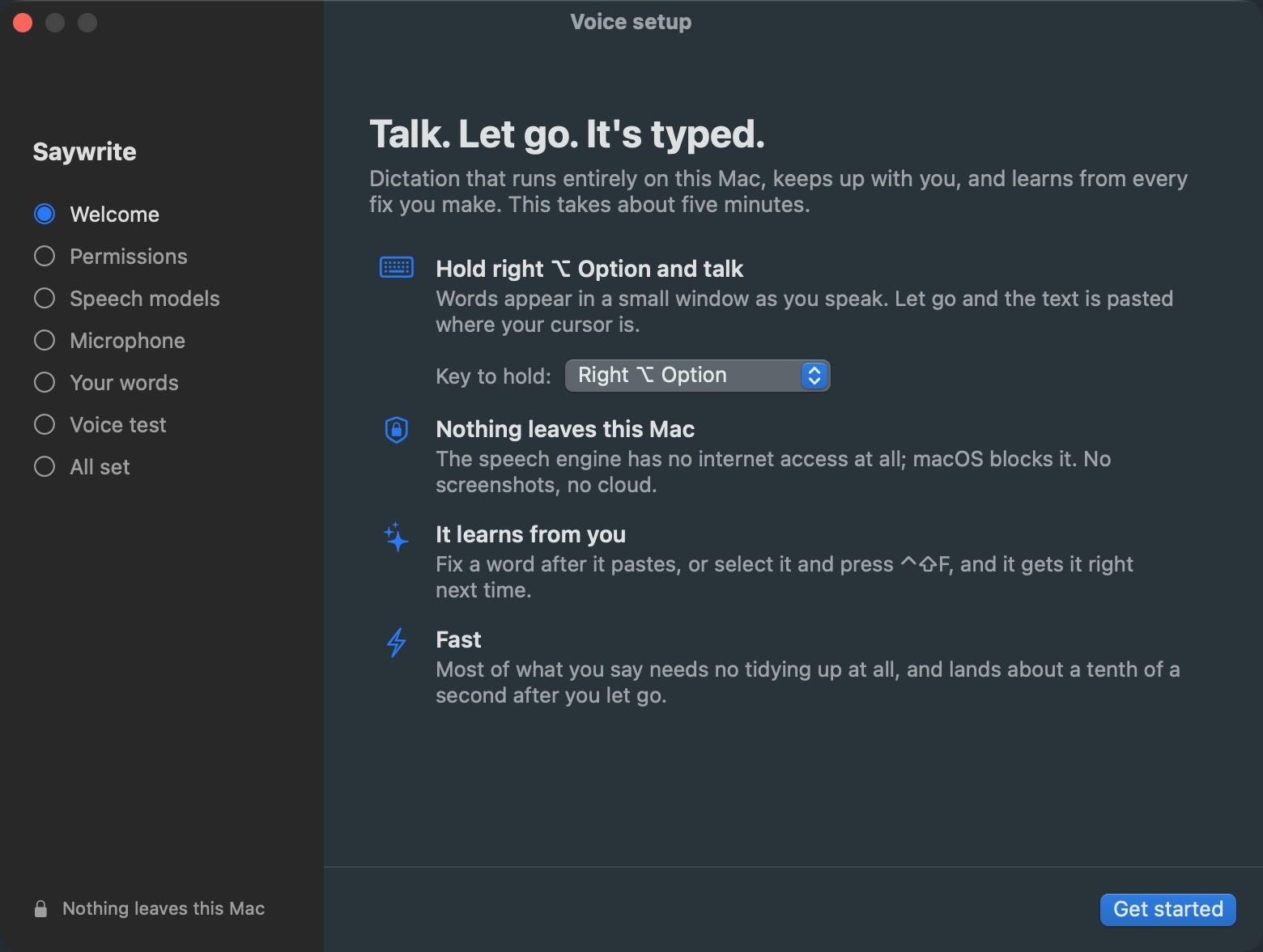
Hold right ⌥ Option and talk. Your words appear in a small window as you speak. Let go, and the text is pasted where your cursor is. The speech engine runs on your Mac, and nothing leaves it.
Animated illustration, not a screenshot: holding the right Option key, speaking, and letting go. Words appear in Saywrite's floating window, then the finished text is pasted into a Mail message.
Try it: press and hold the key, then let go. Or hold your own right ⌥.
How it works
No app to switch to and no button to find. Saywrite lives in your menu bar and types into whatever you're using: Slack, Mail, your code editor, anywhere with a text field.
Right ⌥ Option to start with. Quick taps under 0.3 seconds are ignored, and pressing any other key while you hold it cancels.
A small floating window sits by your text cursor and shows your words as you say them, so you know it heard you.
The text is pasted where your cursor is. No text field? It says “No text field — copied, press ⌘V”, and the text is waiting on your clipboard.
Most of what you say needs no tidying by a model at all, so it lands about a tenth of a second after you let go.
Cleaned up as it lands
Quick fixes run on every dictation, with no model needed.
um so the release is uh ready for Thursday
So the release is ready for Thursday.
Um, uh and erm are taken out.
let's meet on Tuesday scratch that let's meet on Friday
Let's meet on Friday.
Say “scratch that”, “delete the last three words”, “new line” or “new paragraph”.
the cooper netties cluster is on post grass now
The Kubernetes cluster is on Postgres now.
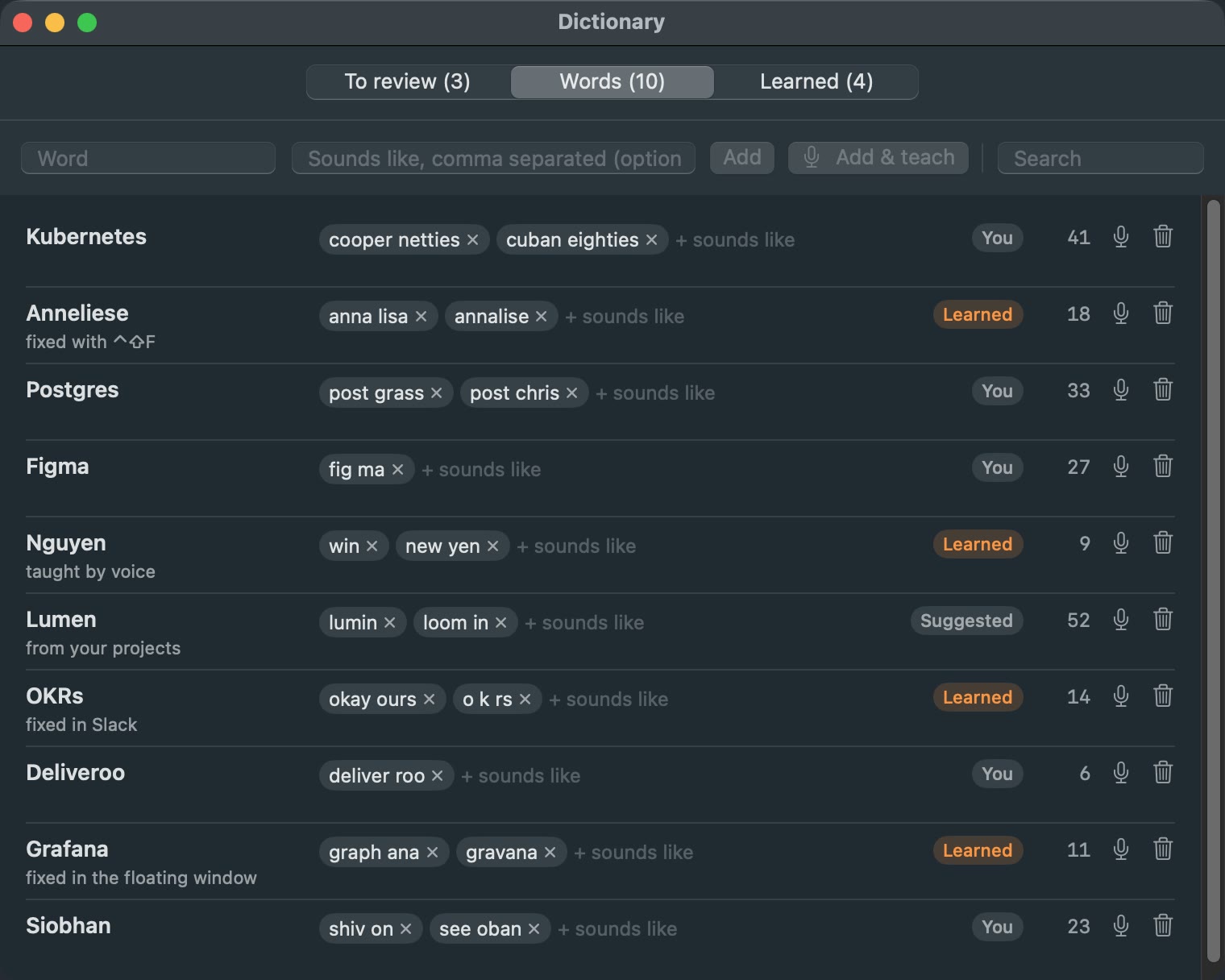
Your dictionary knows how your words sound, so names and jargon come out spelt your way.
For the harder cases, a small language model on your Mac tidies the text. It only runs when it's needed, and you can switch it off from the menu bar.
Saywrite picks a style from the app you're in. In Slack, a single trailing full stop is dropped, so messages read like messages. And it switches itself off in password managers and password fields.
It learns from you
Ordinary dictation keeps getting your colleagues' names and your team's jargon wrong. Saywrite learns them from the fixes you already make.
Private by design
Your voice is turned into text on your Mac, by models that run on your Mac. The speech engine is blocked from the network by macOS itself. No screenshots, no cloud.
Voice setup
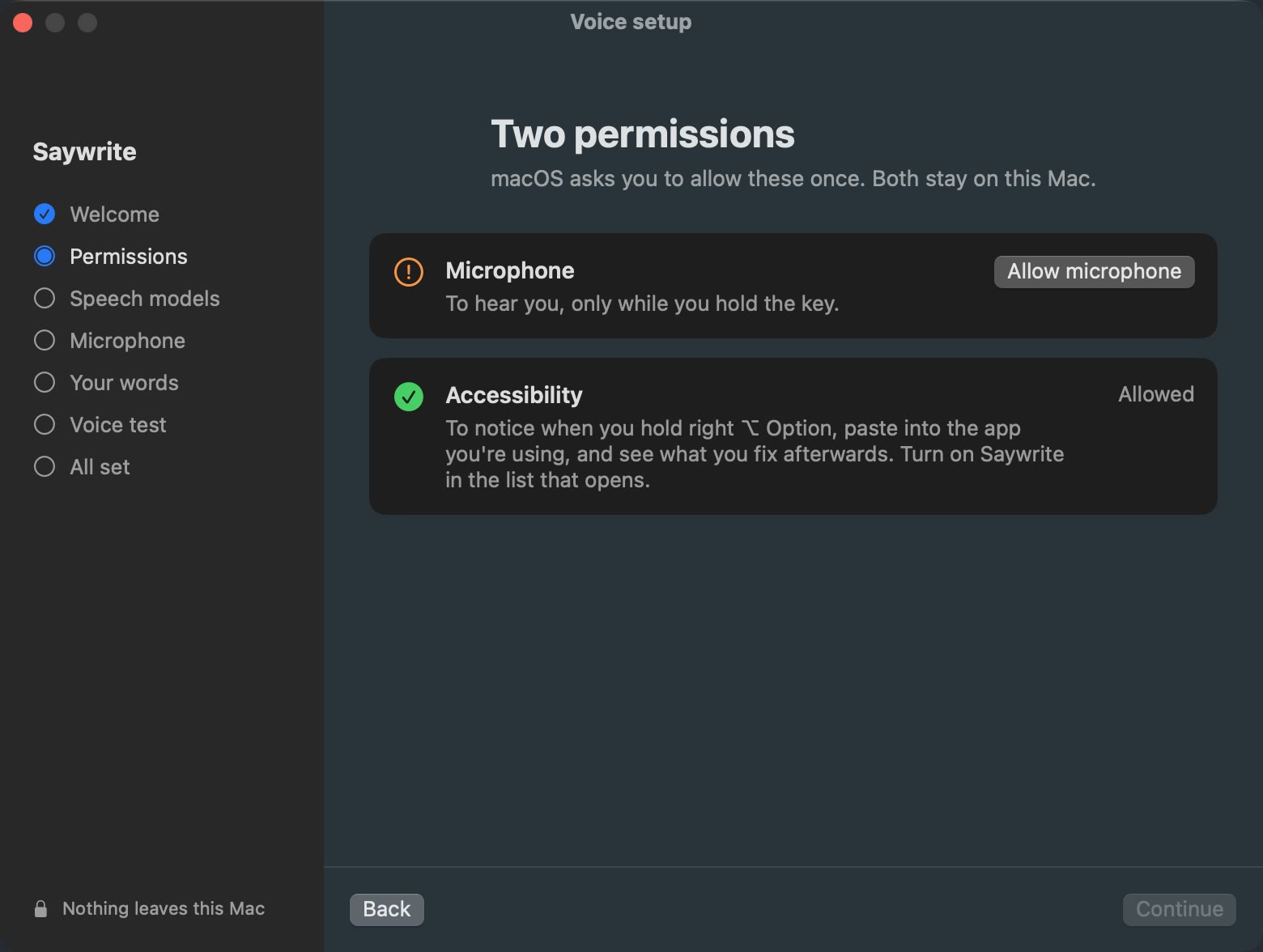
A short guided setup gets Saywrite ready for your voice. It asks for two permissions, downloads the speech models once (about 6 GB), checks your microphone and learns a few of your words. The voice test you record becomes your own test set.
The film
Saywrite is coming soon for the Mac. Email us and we'll tell you when it's out.
Support
Something not working, or an idea for the app? Email [email protected] with your Mac model and macOS version. Replies usually within two working days.
A Mac with Apple silicon running macOS 14 or later. The app is about 434 MB, and Voice setup downloads the speech models once, about 6 GB, so leave room for both.
Only once, to download the speech models from Hugging Face during Voice setup. After that, dictation works with no internet at all. The speech engine is blocked from the network by macOS.
Yes. Open the Saywrite menu in the menu bar and choose Talk key: Right ⌥ Option, Right ⌘ Command, Right ⌃ Control or fn (the Globe key). If you pick fn, set “Press 🌐 key to” to “Do Nothing” in Keyboard settings, or macOS will open emoji or its own dictation as well.
Saywrite couldn't find a text field where your cursor was, so it put the text on the clipboard instead. Click where you want it and press ⌘V.
Select the word anywhere, press ⌃⇧F, type the right spelling and press Enter. It's replaced and remembered. You can also tap the word in the floating window just after it pastes, or add it in the Dictionary with Add & teach and say it three times.
To notice when you hold the talk key, paste into the app you're using, and read the text field so it can pick the right style and learn from the fixes you make. It doesn't ask for Input Monitoring, and the microphone is only used while you hold the key, or during the microphone check in Voice setup.
That's on purpose. Saywrite switches itself off in password managers and password fields.
Only when it helps: when you correct yourself (“no wait”, “I mean”), start an email with a greeting, or say more than 60 words. Everything else is tidied with quick rules, which is why most text lands in about a tenth of a second. You can turn the model off with Tidy with the local model in the menu.
In a folder on your Mac. Choose Open data folder from the menu to see it: your dictionary, the review list, a history of your dictations and the last recording. They're plain files, and deleting the folder removes them. See the Saywrite privacy policy.
Soon. Saywrite is being prepared for release. Email [email protected] and we'll tell you when it's out.